
Set up your onchain wallet and funds
Before interacting with any onchain perpetual protocol, you must establish a secure, funded environment. This foundational step involves configuring a self-custody wallet and ensuring it holds sufficient native currency for gas fees alongside the required collateral.
Configure a secure self-custody wallet
Use a reputable non-custodial wallet such as MetaMask or Trust Wallet. These tools allow you to interact directly with blockchain smart contracts without handing over control of your assets to a centralized exchange. Ensure your seed phrase is stored offline and never shared. Security is paramount; a compromised wallet means total loss of capital.
Fund the wallet correctly
Transfer assets to your wallet address on the specific blockchain network where the perpetual protocol operates. For example, if the protocol runs on Ethereum, you must hold ETH for gas fees and the stablecoin or token designated as collateral (e.g., USDC). Insufficient gas will cause transactions to fail, while incorrect network selection can result in lost funds.
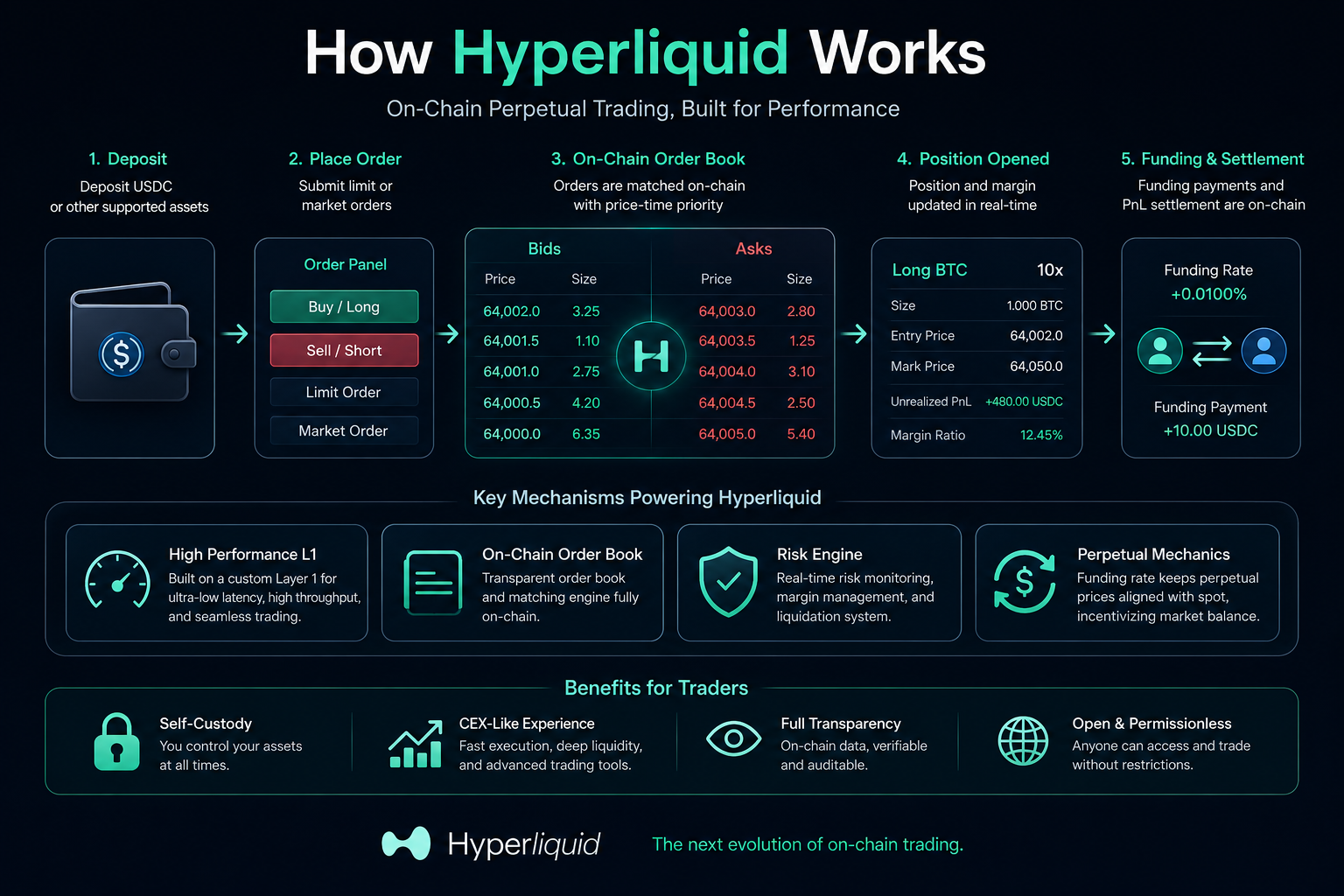
Download and install a trusted wallet application. Complete the initial setup by securely backing up your recovery phrase in a physical, offline location. Never digitize this phrase.
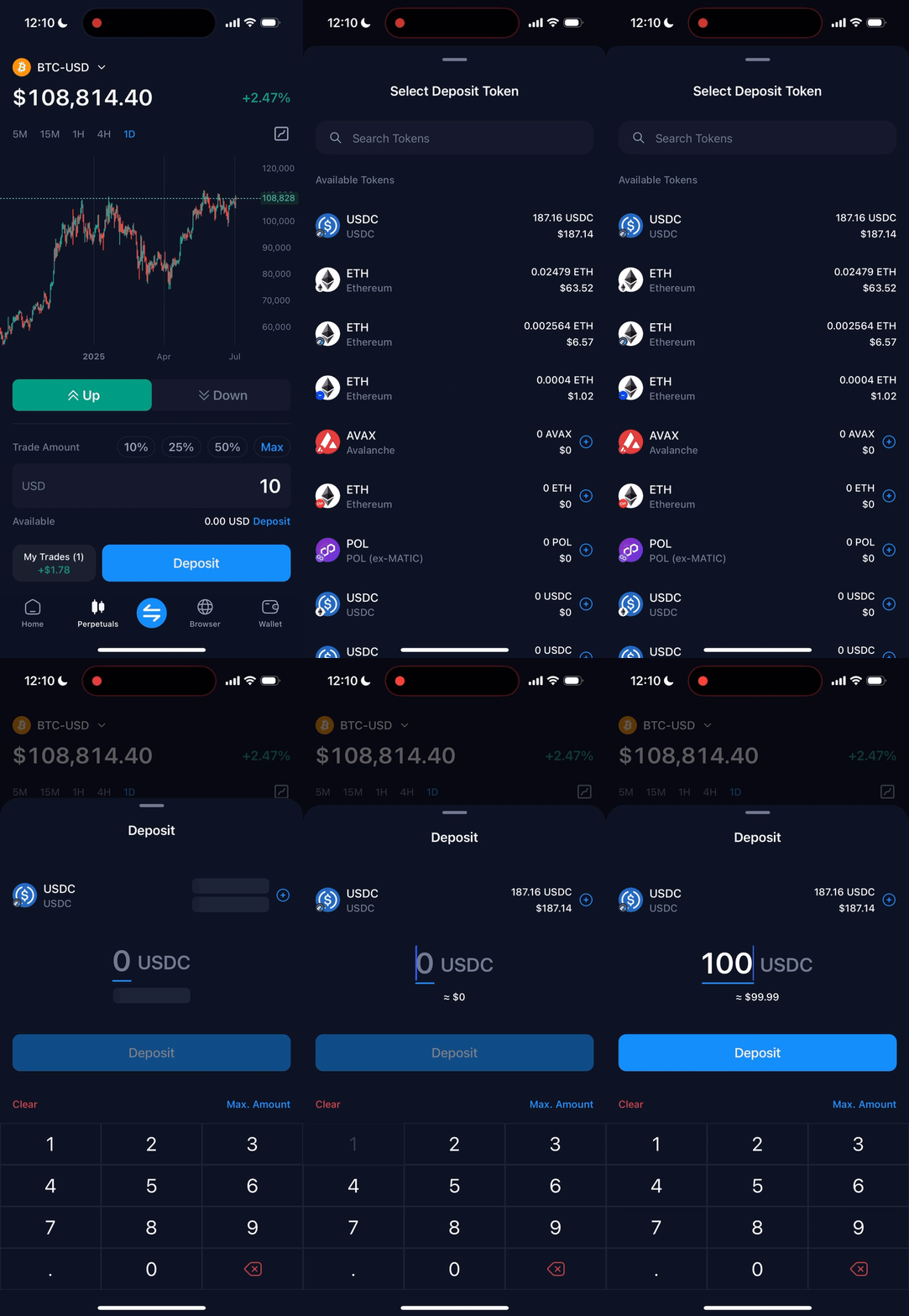
Transfer your chosen collateral asset (e.g., ETH, USDC) from an exchange or another wallet to your new address. Ensure you also leave enough native currency (ETH, MATIC, etc.) to cover transaction fees for the first few interactions.
Confirm that your wallet is connected to the correct blockchain network supported by the perpetual protocol. Switching networks incorrectly can lead to failed transactions or loss of funds if assets are sent to the wrong chain.
Once your wallet is secured and funded, you are ready to connect to a protocol interface. Remember that onchain perpetuals require you to manage your own risk; there is no customer support to reverse mistakes. Proceed with caution and start with small positions to familiarize yourself with the flow.
Calculate initial and maintenance margin
Opening and holding a perpetual position requires two distinct amounts of collateral. Confusing the two is the fastest way to trigger an unwanted liquidation.
Initial margin is the entry fee. It is the minimum collateral required to open the trade. If you want to control a $10,000 position at 10x leverage, you must lock up $1,000 in your account.
Maintenance margin is the survival floor. It is the lower, ongoing minimum balance required to keep the position open. If your account value drops below this threshold, the exchange will liquidate your position to protect the lender.
The math behind the numbers
The calculation for initial margin is straightforward. It is simply the total position size divided by your leverage ratio.
Initial Margin = Position Size ÷ Leverage
For example, a $5,000 position at 5x leverage requires $1,000 in initial margin. However, maintenance margin is not a fixed percentage of leverage. It is a specific dollar amount set by the exchange, often expressed as a maintenance margin rate.
Comparison of margin types
| Feature | Initial Margin | Maintenance Margin |
|---|---|---|
| Purpose | Opens the position | Keeps the position open |
| Amount | Higher (e.g., 10% for 10x) | Lower (e.g., 4-5% for 10x) |
| Trigger | Required at entry | Triggered during liquidation |
| Variability | Fixed by leverage | Fixed by exchange rules |
Source: MetaMask Perpetuals Guide
Why the gap matters
The difference between initial and maintenance margin is your buffer against volatility. This buffer is known as your "margin buffer." A wide buffer gives you more room for the market to move against you before liquidation occurs. A narrow buffer means even small price swings can wipe out your position.
When leverage increases, the initial margin requirement decreases, but the maintenance margin gap often shrinks faster. This makes high-leverage positions significantly more fragile. Always calculate the maintenance margin level before entering a trade to understand your true risk exposure.
Tools for margin calculation
Using a calculator to verify your margin requirements is essential. Manual calculations can lead to errors, especially when dealing with complex leverage ratios or cross-margin modes.
Recommended Resources
To manage your margin effectively, consider using tools that automate these calculations and provide real-time risk alerts.


As an Amazon Associate, we may earn from qualifying purchases.
Execute the trade with precise leverage
Opening a position on a decentralized exchange (DEX) requires more than just clicking "buy." You are interacting with smart contracts that will liquidate your collateral if the market moves against you. The interface is your control panel; treat it with the precision of a trading terminal, not a consumer app.
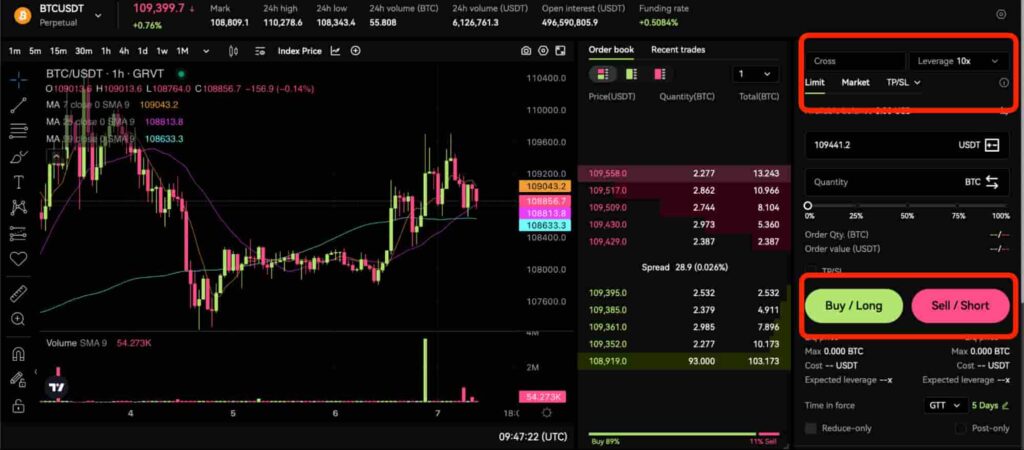
Before entering the trade amount, locate the margin mode selector. Isolated margin limits your loss to the specific collateral you allocated to this position. Cross margin pools all your wallet balance as collateral. For risk-first trading, isolated is the default. It prevents a single bad trade from draining your entire portfolio.
Leverage amplifies both gains and liquidation risk. If you have $1,000 in collateral and select 10x leverage, you control a $10,000 position. The interface should display the "Initial Margin" required. Remember the formula: Position Size × Mark Price ÷ Leverage. If the interface allows you to input the position size directly, ensure your collateral covers the initial margin plus a buffer for fees.
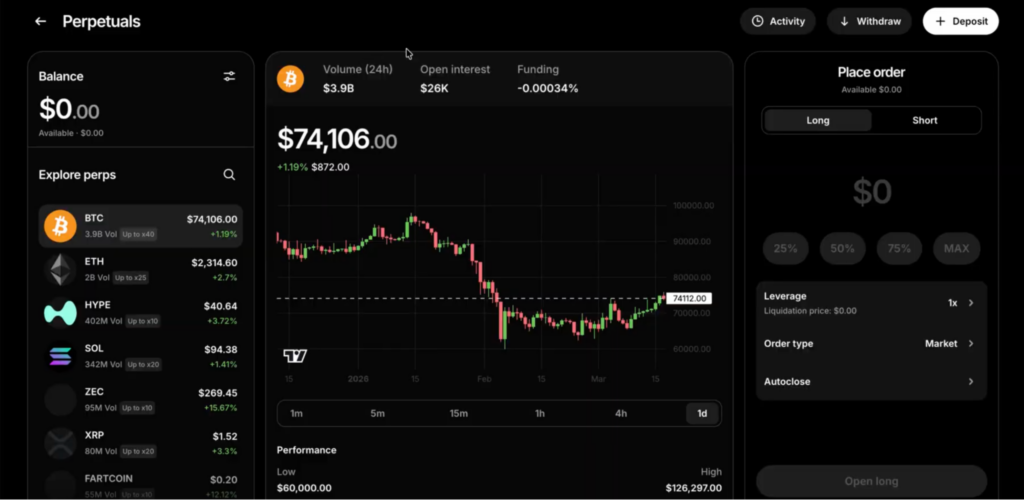
Never open a perpetual position without an exit strategy. Use the "Post-Only" or "Reduce-Only" toggle for your stop-loss. This ensures your order only executes if it reduces your exposure, preventing accidental market orders during volatility. Set your stop-loss at a level that respects the asset's normal volatility, not just your emotional comfort zone.

DEX interfaces often show a "Slippage Tolerance" setting. For stable pairs, keep this low (0.5% or less). For volatile assets, you may need to increase it slightly to ensure execution, but higher slippage means you get a worse entry price. Review the total estimated fees, including gas and trading fees, before signing the transaction. Once signed, the trade is irreversible on-chain.
Monitor real-time risk analytics
On-chain perpetual futures remove the intermediary, but they do not remove the risk of liquidation. When you trade without a centralized clearinghouse, you are responsible for tracking your own exposure against volatile market conditions. Relying on delayed end-of-day reports is insufficient for high-stakes margin trading. You must monitor three critical data points in real time: funding rates, liquidation prices, and overall portfolio health.
Track funding rates for cost and sentiment
Funding rates are periodic payments exchanged between long and short positions to keep the perpetual contract price tethered to the underlying spot asset. A positive rate means longs pay shorts; a negative rate means shorts pay longs. Extreme positive rates often signal over-leveraged long positions, increasing the cost of holding a trade and potentially triggering a cascade of liquidations if the market reverses.
Use on-chain data tools to view current funding rates across major protocols. This data helps you gauge market sentiment and anticipate volatility. If funding rates spike to unusual levels, consider reducing position size or hedging your exposure to avoid paying excessive fees.
Set precise liquidation price alerts
Your liquidation price is the point at which your collateral is insufficient to cover losses, and the protocol automatically closes your position. Unlike centralized exchanges that may offer grace periods or insurance funds, on-chain liquidations are often immediate and can result in total loss of margin plus liquidation penalties.
Calculate your exact liquidation price based on your entry price, leverage, and the protocol’s maintenance margin requirements. Set up real-time alerts for when your position approaches this threshold. Do not wait for the liquidation event to react. If you see your margin ratio dropping, have a plan to either add collateral or reduce exposure before the protocol forces a close.
Monitor portfolio health and open interest
Beyond individual positions, monitor your total portfolio health. This includes your unrealized PnL, total margin ratio, and the broader open interest in the market. Sudden drops in open interest can signal large exits or market shifts that may impact your positions.
Use on-chain dashboards that aggregate data from multiple protocols. These tools provide a holistic view of your risk exposure. Regularly review your portfolio to ensure your leverage levels align with your risk tolerance. Adjust your positions proactively based on market conditions rather than reacting to losses after they occur.
Close positions and withdraw collateral
Exiting an onchain perpetual margin position requires precision. A rushed close can trigger slippage or unnecessary funding fees, eroding profits. The goal is to secure your capital efficiently while minimizing transaction costs on the blockchain.
1. Execute the Close Order
Navigate to your active positions dashboard. Select the specific perpetual contract you wish to exit. Choose "Close Position" or "Market Close" to liquidate the entire position immediately. If you prefer partial profit-taking, enter the exact amount of contracts or collateral to close. Confirm the transaction details, ensuring the estimated slippage is within your acceptable limit before signing with your wallet.
2. Settle and Withdraw
Once the position is closed, your collateral remains in the protocol’s smart contract. Do not leave funds idle in the trading interface. Navigate to the "Withdraw" or "Bridge" section of the platform. Initiate a transfer of your remaining collateral back to your primary hot wallet or a secure cold storage solution. Verify the destination address carefully to prevent irreversible loss.
3. Confirm Transaction Hash
After initiating the withdrawal, wait for the blockchain confirmation. Copy the transaction hash (TXID) from your wallet or the platform’s activity log. This hash serves as your immutable proof of settlement. Store it securely for tax reporting or dispute resolution if the protocol experiences technical issues. Do not assume the funds are safe until the TXID shows multiple confirmations on the explorer.
Common onchain perpetual margin mistakes
Leverage amplifies both gains and liquidation risk. The most frequent error is over-leveraging relative to account volatility. While some exchanges advertise maximum leverage up to 125x, using such high ratios leaves minimal room for price fluctuations. A small adverse move can wipe out your entire initial margin, which is the collateral required to open the trade.
Funding rates are periodic payments between long and short traders to keep perpetual prices aligned with spot. Ignoring these costs can erode your margin over time, especially if you hold positions across multiple funding intervals. Always check the current rate before entering a trade.
Without a stop-loss, you rely on the exchange’s liquidation engine to close your position. This often happens at unfavorable prices, incurring additional liquidation fees. Set a stop-loss order to define your maximum loss before opening the position.
Maintenance margin is the minimum collateral required to keep your position open, typically lower than the initial margin. If your account balance falls below this level due to market moves, your position will be liquidated. Monitor your margin ratio in real-time to avoid surprise closures.
These pitfalls are not just theoretical; they are the primary reasons traders lose capital in perpetual futures. Treat margin as a risk management tool, not just a way to increase position size. By respecting leverage limits and monitoring funding rates, you protect your capital from unnecessary liquidation.
No comments yet. Be the first to share your thoughts!