
Understand margin requirements
Manage Onchain Perp Margin Without Getting Liquidated works best as a clear sequence: define the constraint, compare the realistic options, test the tradeoff, and choose the path with the fewest hidden costs. That order keeps the advice usable instead of decorative. After each step, pause long enough to check whether the recommendation still fits the reader's actual situation. If it depends on perfect timing, unusual access, or a best-case budget, include a simpler fallback.
The simplest way to use this section is to write down the real constraint first, compare each option against it, and choose the path that still works outside ideal conditions.
Calculate your leverage ratio
Leverage is the multiplier that determines how much market exposure you control relative to your own capital. On perpetual futures, your leverage ratio is calculated by dividing the total position size by the initial margin (the collateral required to open the trade). A higher ratio amplifies both potential gains and the risk of liquidation.
To avoid over-leveraging, you must anchor your position size to your available collateral. The formula is straightforward: position size multiplied by the mark price, divided by the leverage factor. For example, at 10x leverage, opening a $10,000 position requires $1,000 in initial margin. This means your collateral must cover at least that amount, plus a buffer for fees and adverse price movements.
The danger lies in confusing your total account balance with your usable margin. If you allocate 100% of your funds to a single high-leverage trade, even a small market fluctuation can trigger a liquidation event. MetaMask explains that initial margin is the collateral required to open a trade, while maintenance margin is the lower ongoing minimum required to keep the position open. Your leverage calculation should always account for the maintenance margin threshold, which is the price level where your position is forcibly closed.
A practical rule of thumb is to never risk more than 1-2% of your total capital on a single trade. If you have $10,000 in collateral, a 1% risk tolerance means you should structure your position so that a stop-loss or liquidation event only costs you $100. This requires calculating the inverse: determining the maximum position size that keeps your potential loss within that 1% boundary, rather than simply picking an arbitrary leverage number like 20x or 50x.
Set up your position safely
Opening a perpetual futures trade on-chain requires more than just clicking "Open Position." You must configure margin settings and collateral buffers before the trade goes live. A single miscalculation in leverage or margin mode can trigger immediate liquidation, regardless of your market analysis. This workflow ensures you enter the market with a structural safety net.
Margin mode determines which assets back your position. Isolated margin confines risk to the collateral allocated to that specific trade. If the position is liquidated, you only lose that allocated amount. Cross margin uses your entire wallet balance as collateral. This lowers the liquidation price but exposes your entire portfolio to risk. For most traders, isolated margin is the safer default for new positions.
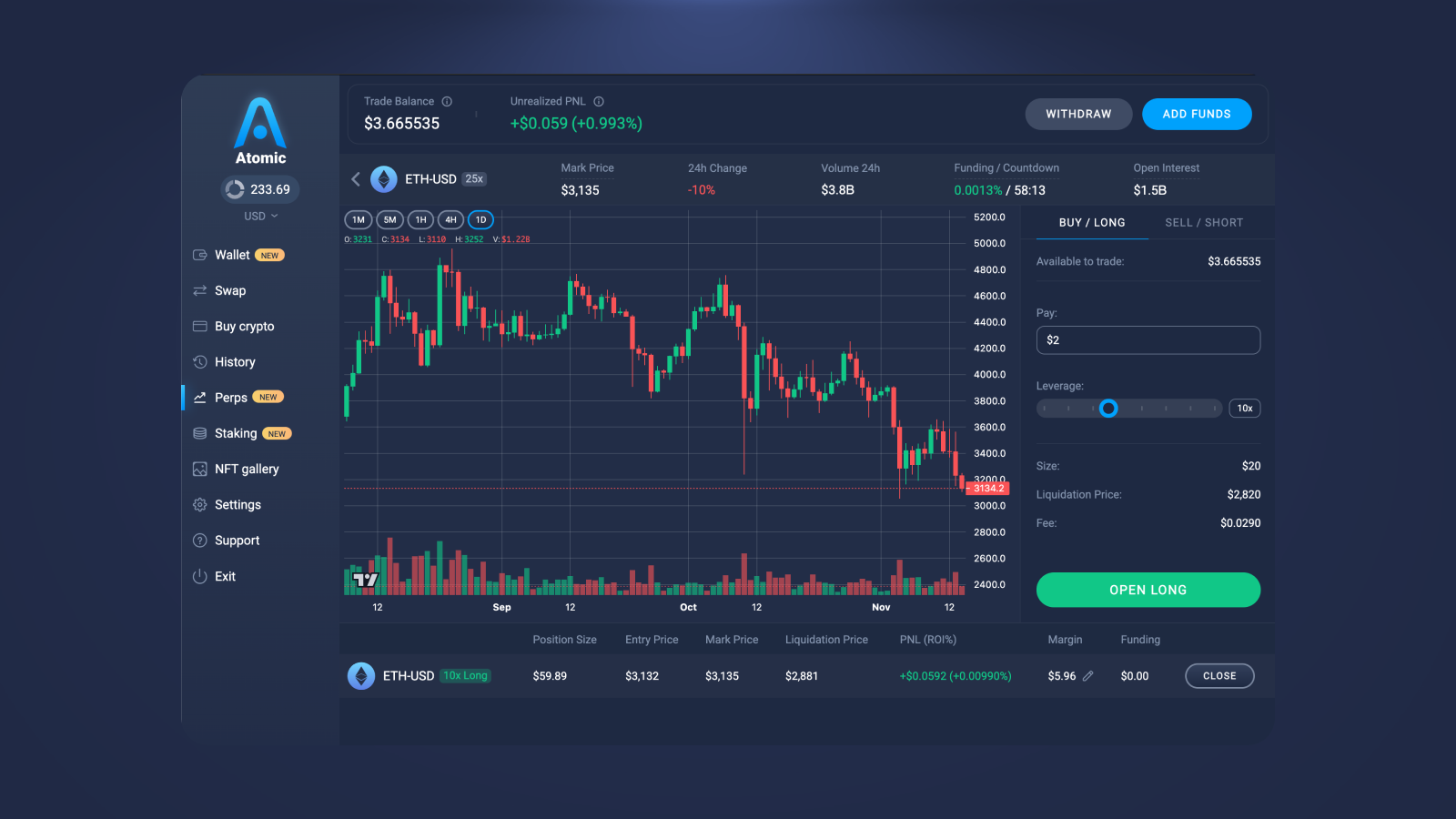
Initial margin is the minimum collateral required to open the trade. It is calculated as Position Size × Mark Price ÷ Leverage. If you want to open a $10,000 position at 10x leverage, you need $1,000 in initial margin. Ensure your wallet has sufficient funds to cover this amount plus transaction fees. Underfunding the transaction will cause the order to fail or leave you with zero buffer.
Leverage amplifies both gains and losses. Higher leverage lowers your liquidation price, making it easier for the market to wipe out your position. For example, 50x leverage means a 2% move against you triggers liquidation. Start with low leverage (2x-5x) to understand the mechanics. You can always increase leverage later if the position is profitable and you have a safety buffer.

Maintenance margin is the minimum equity level before liquidation occurs. If your position value drops below this threshold, the protocol will automatically close your trade. Set your position size so that your equity remains well above the maintenance margin even during high volatility. A common rule is to ensure your liquidation price is at least 5-10% away from the current market price.

Before confirming, review all parameters: entry price, leverage, margin mode, and collateral amount. Check that the estimated liquidation price aligns with your risk tolerance. Remember that on-chain transactions are irreversible. Once you sign, the trade is live. Take a moment to breathe and confirm every number is correct.
Monitor liquidation price
Manage Onchain Perp Margin Without Getting Liquidated works best when the purchase path is explicit. Verify the source, compare the offer against real alternatives, check the total cost, and confirm what happens after payment before you decide. After each comparison, write down the one risk that would change your mind. If the seller, condition, support, warranty, shipping, or upkeep still feels uncertain, resolve that question before moving to checkout.
The simplest way to use this section is to verify the seller, compare the total cost, and resolve the biggest risk before you commit.
Common margin mistakes
Perpetual futures trading is unforgiving of small errors. A single misstep in margin management can wipe out your position, regardless of your market analysis. The most frequent errors involve misunderstanding collateral requirements and ignoring hidden costs.
Underestimating maintenance margin
Many traders focus only on the initial margin needed to open a trade. They forget that onchain perp margin requirements shift as the market moves. If your position size grows relative to your collateral, you approach the maintenance margin threshold. A sudden price swing can trigger liquidation before you realize your buffer is gone. Always calculate the distance to liquidation based on current mark prices, not entry prices.
Ignoring funding rates
Funding rates are periodic payments between longs and shorts that keep perpetual prices close to spot. If you hold a position for days or weeks, these rates accumulate. Paying high funding rates can erode your collateral balance over time, effectively raising your liquidation price. Check the current funding rate on the protocol before entering a long-term position.
Confusing cross and isolated margin
The margin mode you choose determines how much collateral backs your trade. Isolated margin limits risk to the specific allocation for that position. Cross margin uses your entire wallet balance as collateral. While cross margin offers more flexibility, it also exposes your entire portfolio to a single bad trade. Understanding the difference is critical for risk control.
Final checklist for safe trading
Before you open a position, treat your margin like a seatbelt, not a decoration. The difference between a healthy trade and a liquidation often comes down to two numbers: initial margin and maintenance margin [MetaMask]. Initial margin is the collateral you lock to enter the trade. Maintenance margin is the lower threshold your account must maintain to stay open [MetaMask].
Use this sequence to keep your positions safe:
- Check the ratio: Ensure your margin ratio stays well above the maintenance requirement. A small buffer accounts for slippage and volatility.
- Set stop-losses: Define your exit price before entering. Onchain perps lack circuit breakers, so price can move fast [A16Z].
- Monitor liquidation price: Keep an eye on your liquidation level relative to current market price. Don't wait for the alert to react.
- Review fees: Trading fees and funding rates eat into margin. Factor these into your break-even calculation.
Staying liquid means respecting the math. If the position size exceeds your margin capacity, the protocol will close your trade automatically.
No comments yet. Be the first to share your thoughts!