

Unified Margin Cross-Chain Perpetuals: Minimize Liquidation Risks with Multi-Chain Collateral 2026

In the high-octane world of DeFi perpetuals, where trading volumes on decentralized exchanges surged to $12.08 trillion by the end of 2025, traders face a relentless battle against liquidation risks. Annual transactions hit $7.9 trillion, underscoring the explosive demand for cross-chain perpetuals trading. Yet, siloed blockchains fragment collateral, turning minor drawdowns into portfolio-wide catastrophes. Enter unified margin perps: a game-changer that pools multi-chain assets into a single, resilient margin buffer, slashing liquidation threats while unlocking capital efficiency.


This evolution isn’t hype; it’s necessity. Platforms like Yamata and Blitz pioneered cross-margin systems, where all positions tap a shared pool. Gains from a Solana long offset Arbitrum shorts, stabilizing the entire setup. OnchainPerpMargin. com takes this further, offering seamless multi-chain collateral management tailored for pros navigating 2026’s volatile perps landscape.
Perp DEX Volumes Signal a Cross-Chain Imperative
Perpetual futures DEXs didn’t just grow; they redefined DeFi’s scale. That $7.9 trillion in 2025 volume dwarfs centralized rivals, fueled by protocols on Solana, Hyperliquid, and Arbitrum. Forbes predicts unified terminals could handle 40% of DeFi volume by 2030, bridging spot, perps, and copy trading across chains. But fragmentation persists: locked BTC on Ethereum can’t hedge ETH perps on Solana.
Hyperliquid’s unified system exemplifies this shift, with HIP-4 contracts leveraging the same engine. Traders hold longs across assets without margin silos, a model echoed by Kyan’s portfolio-level risk re-architecture. OnchainPerpMargin. com mirrors this, optimizing cross-margin perpetuals 2026 for real-time analytics and position netting.
Unified Margin Mechanics: From Silos to Synergy
At its core, unified margin consolidates collateral into one pool, netting exposures like delta and gamma across perps and options. MixBytes notes a 30% capital efficiency boost; MEXC’s multi-asset mode echoes this by offsetting P and L universally. GMX on Arbitrum adds RWA collateral, blending yield with hedging via dynamic liquidation thresholds.
Here’s how it unfolds: deposit USDC on Ethereum, wETH on Arbitrum, SOL on Solana. The platform’s risk engine aggregates them, applying unified leverage. A 10% BTC drawdown? Offset by SOL gains, keeping maintenance margin intact. Partial liquidations kick in only as needed, averting cascades. Yet, pitfalls loom: market-wide crashes amplify shared pool stress, demanding vigilant risk tools.
Charts don’t lie; emotions do. Unified margin turns emotional silos into data-driven fortresses.
OnchainPerpMargin. com’s advanced engine simulates these scenarios, alerting on cascade risks before they materialize. For DeFi liquidation prevention, it’s indispensable.
Real-World Edge: Platforms Pushing Boundaries
Yamata’s docs detail cross-margin perps drawing from shared pools, minimizing isolated wipes. Blitz and Hyperliquid extend this to HyperCore, unifying engines for perps and beyond. Flying Tulip envisions a full-stack unification: spot, lending, perps under one roof. RWA perps on Ostium and Aster introduce Treasuries as collateral, hedging equity perps on-chain.
Chainlink’s oracles ensure transparent settlement, vital for high-speed cross-chain ops. But novices beware: multi-asset complexity spikes. Chaincatcher’s analysis flags cascading risks in downturns, underscoring pro-grade dashboards like OnchainPerpMargin. com’s.
Hyperliquid’s cross-collateral guide illuminates practical setup, aligning perfectly with 2026 trends. Traders report 2-3x position sizing without added risk, a boon in perp DEXs dominating Solana DeFi apps.
That efficiency isn’t theoretical; it’s battle-tested amid 2026’s perp surges. Protocols like Ostium layer RWA perps atop this, letting Treasuries back volatile longs, a hedge techflow dubs the dawn of unified margin networks spanning Bitcoin to equities.
Risk Engine Precision: The Liquidation Shield
Unified margin thrives on sophisticated risk engines, not blind pooling. OnchainPerpMargin. com deploys real-time analytics netting delta across chains, forecasting partial liquidations before they cascade. Yamata’s shared pool mechanics shine here: a 20% ETH dump gets cushioned by Arbitrum gains, maintenance margin holding firm at 5-10%. Blitz mirrors this, but adds dynamic thresholds adjusting to volatility spikes.
GMX’s Arbitrum iteration introduces RWA collateral yields, turning idle US Treasuries into perp buffers. Yet chaincatcher’s caveat rings true: downturns test shared pools hardest. Novices overload on SOL perps, ignoring gamma buildup, and watch cascades wipe 30% of TVL. Pros counter with portfolio simulators, stress-testing multi-chain setups. That’s where DeFi liquidation prevention elevates from gimmick to edge.
Comparison of Unified Margin Platforms: OnchainPerpMargin vs Yamata, Blitz, Hyperliquid
| Platform | Collateral Chains | Efficiency Boost | Risk Features | 2026 TVL Estimate |
|---|---|---|---|---|
| OnchainPerpMargin | Ethereum, Solana, Arbitrum, Hyperliquid | 40% via multi-chain collateral netting | Dynamic thresholds, partial liquidations, cross-chain offsets | $15B |
| Yamata | Solana, Ethereum | 30% from shared margin pool | Gains offset losses across positions, reduced liquidation likelihood | $3B |
| Blitz | Arbitrum, Solana | 30% cross-margin consolidation | Shared pool for all positions, profit/loss netting | $2.5B |
| Hyperliquid | Hyperliquid L1 (HyperCore) | 35% unified cross-margin system | Portfolio-level risk, HIP-4 safeguards against cascading liquidations | $12B |
Capital efficiency jumps 30% per MixBytes, but only with vigilant oversight. Flying Tulip’s stack unifies lending into perps, recycling yields as margin. Kyan re-architects outright, ditching legacy silos for exposure netting. OnchainPerpMargin. com integrates these philosophies, cross-pollinating Hyperliquid’s engine with Solana speed for cross-chain perpetuals trading that anticipates black swans.
Fragmented chains breed fragility; unified margin forges resilience.
Trader Playbook: Mastering Multi-Chain Collateral
Deploying multi-chain collateral management demands strategy. Start lean: 40% USDC Ethereum, 30% wETH Arbitrum, 30% SOL Solana. Net longs in BTC perps against shorts in altcoin futures. Monitor unified P and L; if SOL pumps 15%, it buoys BTC drawdowns, averting 8x leverage wipes. Platforms flag overexposure via heatmaps, prioritizing partial closes on weakest legs.
2026’s RWA twist adds yield: stake Treasuries at 4-5% APY as collateral, hedging equity perps on-chain. Hyperliquid’s HIP-4 proves it, blending spot and perps seamlessly. But scale wisely; chain-wide stress, like a Solana outage, ripples through pools. OnchainPerpMargin. com’s dashboard mitigates with failover bridges and oracle redundancies, Chainlink-powered for settlement fidelity.
Bitcoin Technical Analysis Chart
Analysis by Sarah Davis | Symbol: BINANCE:BTCUSDT | Interval: 1h | Drawings: 7
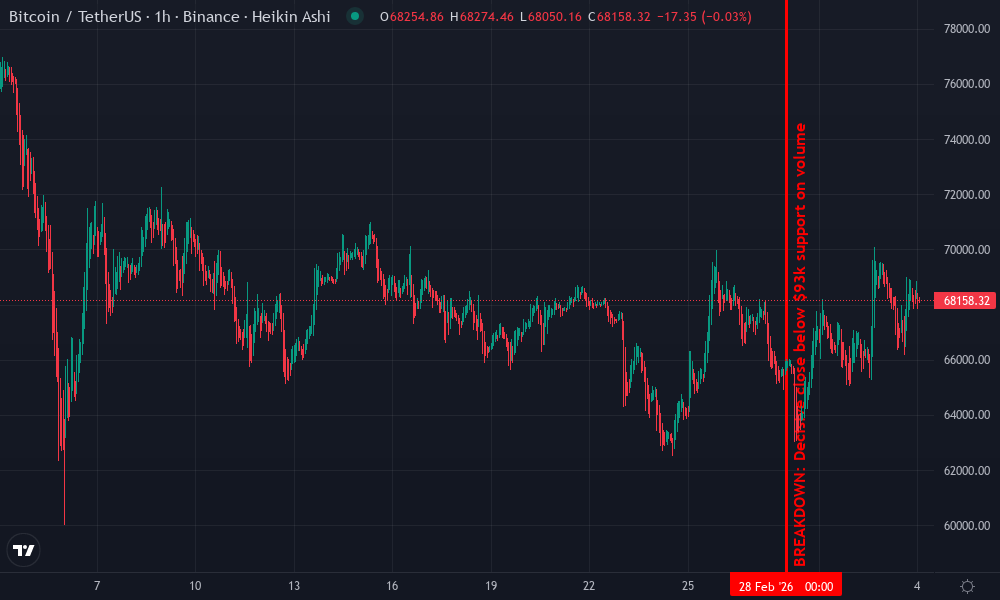
Technical Analysis Summary
As Sarah Davis, start by drawing a prominent downtrend line connecting the swing high on 2026-02-20 at $97,800 to the swing low on 2026-02-28 at $91,400, labeling it ‘Primary Downtrend – Bearish Bias’. Add a secondary uptrend line from the 2026-02-28 low at $91,400 to the 2026-03-02 high at $94,600, marked ‘Bounce Recovery – Watch for Break’. Place horizontal lines at key support $91,400 (strong, thick red) and $93,000 (moderate, dashed orange), resistance at $95,500 (weak) and $97,800 (strong, thick green). Use fib retracement from 2026-02-28 low to 2026-02-20 high: highlight 38.2% at ~$94,200 and 50% at $94,600 as potential entry zones. Rectangle the consolidation range from 2026-02-26 to 2026-03-02 between $93,000-$94,600. Add callouts on MACD for recent bullish crossover near 2026-03-02 and volume spike on downside at 2026-02-28. Arrow up at current price ~$94,400 for potential long entry if holds support. Vertical line at 2026-02-28 for breakdown event. Style: Clean lines, color-coded (bearish red/orange, bullish green/blue), sans-serif labels with confidence % for visual storytelling.
Risk Assessment: medium
Analysis: Structured pullback with clear levels, but perp DEX volatility (unified margins) adds tail risk; Heikin Ashi masks true wicks
Sarah Davis’s Recommendation: Swing long on support hold above $93k, target $97k. Scale in medium position, trail stops—my 10yr balanced approach.
Key Support & Resistance Levels
📈 Support Levels:
-
$91,400 – Multi-test low with volume spike, aligns with 0.618 fib from prior swing
strong -
$93,000 – Mid-range bounce point, prior candle wicks
moderate
📉 Resistance Levels:
-
$95,500 – Recent rejection high on 2026-03-04 approach
weak -
$97,800 – Swing high, downtrend origin
strong
Trading Zones (medium risk tolerance)
🎯 Entry Zones:
-
$93,200 – Near support cluster + fib 23.6%, volume confirmation needed
medium risk -
$94,400 – Current price pullback to uptrend line, MACD support
low risk
🚪 Exit Zones:
-
$97,000 – Profit target at 61.8% fib retrace
💰 profit target -
$90,800 – Below key support invalidates bounce
🛡️ stop loss
Technical Indicators Analysis
📊 Volume Analysis:
Pattern: spikes on downside, drying on upside
Bearish divergence, confirms distribution phase
📈 MACD Analysis:
Signal: bullish divergence / histogram convergence
Zero-line approach from below, potential crossover buy signal
Applied TradingView Drawing Utilities
This chart analysis utilizes the following professional drawing tools:
Disclaimer: This technical analysis by Sarah Davis is for educational purposes only and should not be considered as financial advice.
Trading involves risk, and you should always do your own research before making investment decisions.
Past performance does not guarantee future results. The analysis reflects the author’s personal methodology and risk tolerance (medium).
Opinion: this isn’t incremental; it’s DeFi’s maturity marker. Perp DEXs hit $12 trillion because traders crave control. Unified systems deliver, but only paired with chart discipline. Spot the head-and-shoulders on ETH before the pool strains; exit partials early.
Deep dives reveal nuances. Yamata’s docs stress collateral composability: LSTs like stSOL join the pool, yielding passively. Aster’s RWA perps extend to gold-backed positions, netting vega across options. Yet complexity bites back; novices falter on asset correlations, mistaking offsets for free leverage.
Armed with these tools, 2026 traders sidestep the pitfalls plaguing 2025’s $7.9 trillion frenzy. OnchainPerpMargin. com stands at the vanguard, its risk engine dissecting exposures in real time. Cross-margin isn’t a feature; it’s the new baseline for pros who chart paths through chaos, turning multi-chain mayhem into measured mastery.