

Real-Time Risk Analytics for Cross-Chain Perps Portfolios in 2026

In the volatile arena of decentralized finance, managing cross-chain perpetuals portfolios demands more than intuition; it requires real-time risk analytics perps that cut through multi-chain noise. By 2026, traders face a landscape where positions span Arbitrum, Base, and emerging L1s like Hyperliquid, each with unique liquidity pools and oracle feeds. Unified margin strategies shine here, pooling collateral across chains to buffer against isolated liquidations, yet without precise monitoring, even diversified setups crumble under flash crashes or bridge exploits.

Decoding Cross-Chain Portfolio Risk in a Fragmented Ecosystem
Cross-chain portfolio risk in 2026 hinges on synchronizing disparate data streams. Platforms like Onchainperpmargin. com lead by aggregating real-time positions from multiple blockchains into a single dashboard. This unified view reveals hidden correlations, such as how an Arbitrum RWA perp drawdown cascades to Base futures via shared collateral. I advocate for stress-testing via tools like MVF-Composer, which deploys multi-agent simulations to probe vulnerabilities. In black-swan scenarios, it slashed peg deviations by 57%, proving indispensable for pros handling $10M and portfolios.
Consider ASAS-BridgeAMM’s contained degradation: it throttles risky transfers during adversarial spikes, curbing insolvency by 73%. These aren’t gimmicks; they’re battle-tested against real threats, from oracle manipulations to bridge hacks detected by BridgeShield’s graph networks, boasting 92.58% F1-scores.
Bitcoin Technical Analysis Chart
Analysis by Market Analyst | Symbol: BINANCE:BTCUSDT | Interval: 1D | Drawings: 6
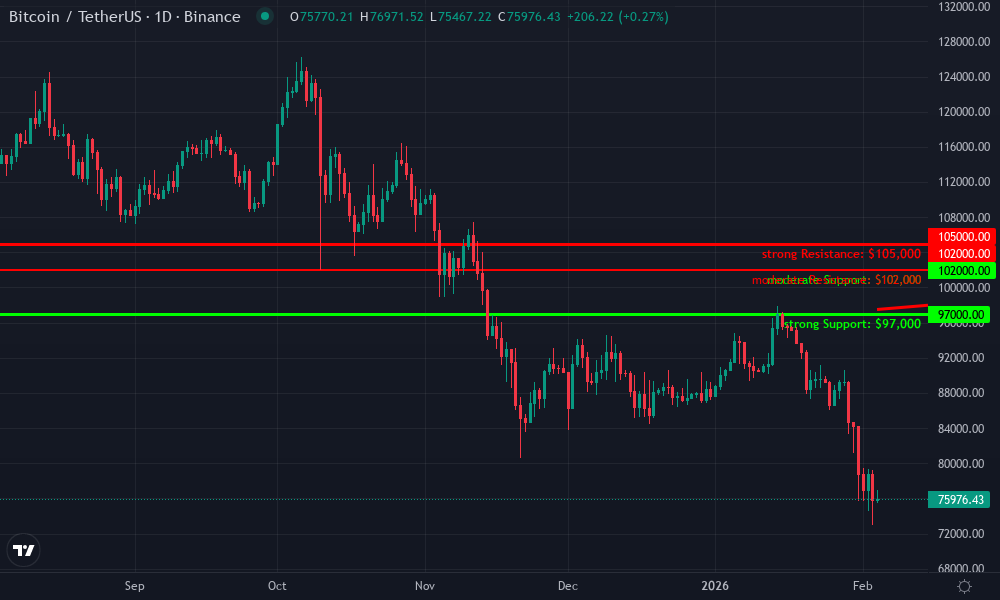
Technical Analysis Summary
As a seasoned technical analyst with a balanced approach, start by drawing a prominent downtrend line connecting the October 2026 high at 108,500 to the recent February low at 97,500, using ‘trend_line’ tool. Add horizontal lines for key support at 97,000 (strong) and resistance at 102,000 (moderate) and 105,000 (strong). Mark a consolidation rectangle from late December 2026 to early January 2027 between 102,000 and 105,000. Use fib_retracement from the major downswing for potential retracement levels. Place arrow_mark_down at the MACD bearish crossover in mid-January and callout for volume spike on the breakdown. Entry long zone at 97,500 support with stop below 96,500 and profit target at 102,000. Risk medium with tight stops.
Risk Assessment: medium
Analysis: Bearish trend intact but oversold with support test; perp DEX advancements may stabilize volatility, but macro caution prevails
Market Analyst’s Recommendation: Scale in longs at 97.5k support with 1-2% risk per trade, target 102k; avoid shorts until confirmed lower low
Key Support & Resistance Levels
📈 Support Levels:
-
$97,000 – Recent swing low with volume support, strong historical test
strong -
$102,000 – November low holding as secondary support
moderate
📉 Resistance Levels:
-
$102,000 – Recent breakdown level, now resistance
moderate -
$105,000 – December rally high, key overhead barrier
strong
Trading Zones (medium risk tolerance)
🎯 Entry Zones:
-
$97,500 – Bounce from strong support in downtrend, volume divergence signals potential reversal
medium risk -
$102,000 – Breakout above resistance for trend continuation confirmation
low risk
🚪 Exit Zones:
-
$102,000 – Initial profit target at resistance flip
💰 profit target -
$96,500 – Tight stop below support to limit downside
🛡️ stop loss -
$108,500 – Stretch target at prior high if bullish momentum builds
💰 profit target
Technical Indicators Analysis
📊 Volume Analysis:
Pattern: spike on breakdown with divergence on pullback
High volume confirms December-January selloff, but lower volume on recent dip suggests weakening bears
📈 MACD Analysis:
Signal: bearish crossover with histogram contraction
MACD line below signal since mid-January, but flattening hints at potential bullish divergence
Applied TradingView Drawing Utilities
This chart analysis utilizes the following professional drawing tools:
Disclaimer: This technical analysis by Market Analyst is for educational purposes only and should not be considered as financial advice.
Trading involves risk, and you should always do your own research before making investment decisions.
Past performance does not guarantee future results. The analysis reflects the author’s personal methodology and risk tolerance (medium).
Unified Margin Liquidation Monitors: The Frontline Defense
The unified margin liquidation monitor has evolved into a predictive powerhouse. Gone are siloed chain alerts; now, systems like Grvt’s risk engine track margins in real-time across perps, spot, and lending, hitting 600,000 trades per second. Hyperliquid’s L1 CLOB adds sub-second finality with zero gas, shielding against MEV attacks that amplify liquidation cascades.
Lyra V2’s portfolio margin takes this further, scenario-weighing entire books to recognize hedges and slash requirements. For a trader long ETH perps on Arbitrum while shorting BTC on Base, this frees capital otherwise locked in overcautious silos. GMX’s RWA integrations on Arbitrum amplify this, blending tokenized treasuries as collateral for yield-bearing hedges, potentially vaulting its token to $15-20 by Q4.
| Platform | Real-Time Monitoring | Liquidation Prevention | Cross-Chain Support |
|---|---|---|---|
| Hyperliquid | 200k orders/sec | MEV protection | L1-native |
| Grvt | 600k trades/sec | AI margin alerts | Multi-asset |
| Lyra V2 | Scenario-based | Portfolio hedges | Portfolio margin |
| GMX Arbitrum | RWA feeds | Unified collateral | Cross-margin |
This table underscores why multi-chain perps analytics favor platforms blending speed with foresight. Retail pilots, like Perpetuals. com’s 92% losing trade filter on BTC-USD-PERP, hint at institutional edges filtering noise before it hits.
Oracles and AI: Fueling Accurate, Actionable Insights
Perp DEXs thrive or falter on oracle fidelity. In 2026, networks aggregate feeds with cryptographic proofs, ensuring fair pricing amid volatility. Real-time proving unlocks cross-chain margin, letting appchains open positions backed by L1 collateral – a game-changer for capital efficiency.

> Go to https://t.co/zychTRgY9W
> Connect any wallet (RISE Wallet = gas-free)
> Trade
Full walkthrough: https://t.co/03RAoYsNkL
And please share your thoughts:
– Discord: https://t.co/wMXiQVZM4A
– Telegram: https://t.co/pW1ZTjBAA4

CipherOwl’s AI layers scan for laundering via transaction forensics, vital as stablecoins cement as institutional rails with 24/7 settlement. ConneX traces bridge pairs with 97% accuracy, exposing illicit flows post-hack. Opinion: pair these with Extended’s cross-asset unification – ex-Revolut builders fusing perps, spot, lending – and you’ve got portfolios resilient to 2026’s wild swings.
Whales eye perp DEX airdrops, but sustainability trumps hype. My take: prioritize risk engines over leverage gimmicks; in unified margin eras, analytics dictate survival.